

Trades survey 2026: Workloads and costs
28 October 2026Posted by:
Viveka Alvestrand
Content Marketing Manager, Trade Direct Insurance
Busy, but under pressure: what tradespeople told us about business in 2026
Our October Trade Talk survey asked 251 tradespeople how business is going this autumn. Most said they're keeping busy, but new work isn't coming in at the same rate for everyone. And rising costs are adding to the pressure.
A busy diary can be a good sign. But it doesn't always mean more work is coming in than last year, or that jobs are costing the same to complete.
So, how are tradespeople finding business right now?
We put the question to readers of Trade Talk, our monthly newsletter, asking about their workloads, incoming jobs and the biggest challenges they're facing.
With 251 responses from different trades and regions across the UK, the results give us a snapshot of business as we head towards the end of 2026.
Respondents worked across a wide mix of trades, including electricians, plumbers, builders, carpenters, heating engineers, roofers and landscapers. Their answers give us a starting point for exploring how business conditions differ across the trades.
And while the overall findings are mixed, looking at the responses by region reveals some differences worth exploring.
Here's what we found.
How busy are tradespeople at the moment?
There's plenty of activity among those who took part in our survey.
61% said they were very or fairly busy, while another 24% described business as steady.
That means 85% of respondents reported being busy or maintaining a steady workload.
Meanwhile, 15% said things were quieter than usual or very quiet.
So, despite the challenges facing the industry, most respondents still have work on the go.
The bigger question is whether that level of activity is being matched by new jobs coming through.

Is more work coming in than last year?
A busy workload today doesn't necessarily mean a growing pipeline of jobs.
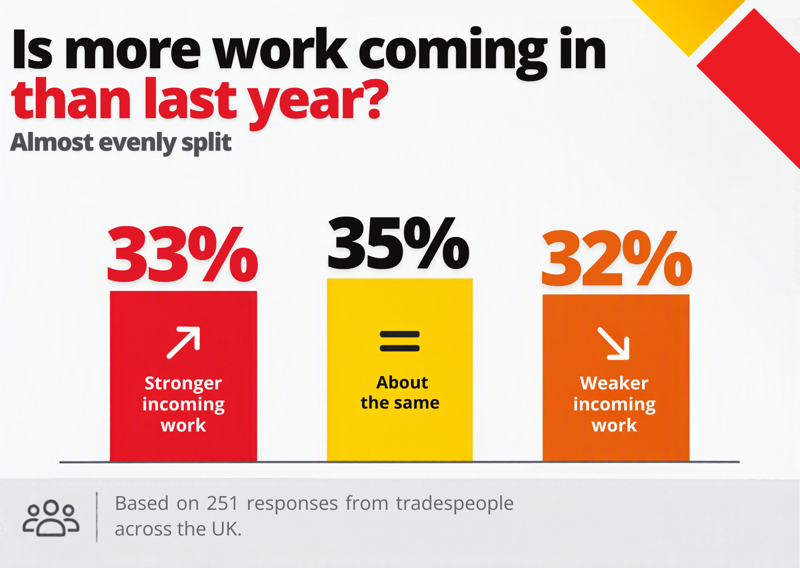
When we asked respondents to compare incoming work with the same time last year, the results were almost evenly split.
• 33% reported more incoming work
• 35% said it was about the same
• 32% reported less incoming work
There's no clear direction here. Roughly as many respondents are seeing an increase in new work as those reporting a drop.
This paints a different picture from the headline workload figures.
While 85% described business as busy or steady, nearly a third reported fewer new jobs coming in than a year ago.
It suggests that current workloads and future work prospects aren't necessarily moving in the same direction.
For tradespeople planning their next few months, the difference between having jobs booked and seeing new enquiries come through can be significant.
How does business compare across the UK?
The overall results show a mixed picture. But look at the responses by region, and some clearer differences start to emerge.
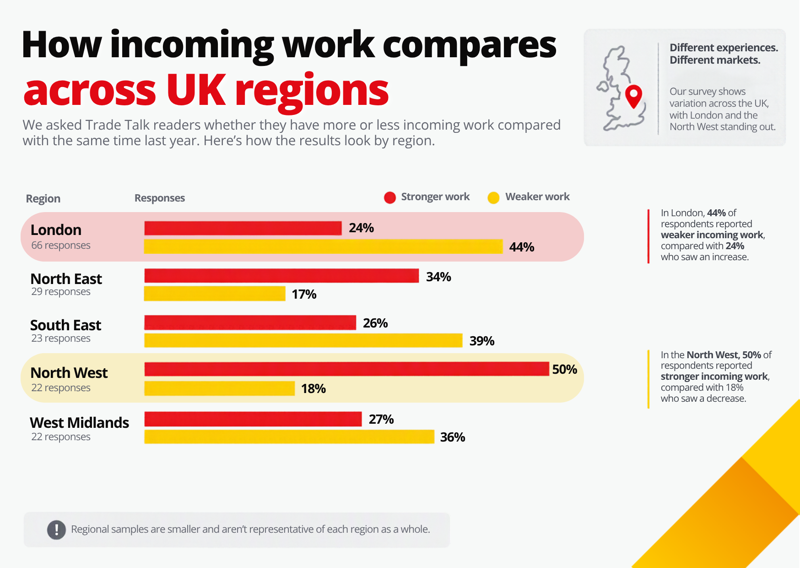
In London, 44% of respondents said incoming work was weaker than this time last year, compared with 24% who reported an increase.
It's a different picture in the North West, where 50% reported stronger incoming work and just 18% said it had weakened.
The North East also stands out when it comes to current workloads. Here, 83% described themselves as very or fairly busy, compared with 52% in London and the South East.
These differences suggest that tradespeople aren't experiencing the same conditions everywhere.
But there's an important distinction between being busy and seeing new jobs come through.
London respondents, for example, were more likely to report weaker incoming work than stronger work. In the North West, the opposite was true.
Of course, these are relatively small regional samples, so they don't tell us how an entire region is performing. But they do show how much the experiences of those who took part can vary depending on where they're based.
What's putting the most pressure on trade businesses?
Having work booked is only part of running a trade business. There's also the cost of getting those jobs done.
And that's where the biggest pressures are showing up.
When asked to identify their single biggest business concern, respondents put everyday operating costs at the top of the list.
• 25% chose fuel and running costs
• 23% selected rising material and equipment costs
• 16% identified late payments
• 15% pointed to customers delaying or cutting back on work
• 11% selected finding skilled people or extra help
• 4% said not having enough work was their biggest concern
Together, fuel, running costs, materials and equipment accounted for 48% of responses.
That's almost half of those surveyed choosing a cost-related issue as their single biggest pressure.
There's another distinction worth noting.
Only 4% picked a lack of work as their biggest concern. Yet 32% reported fewer incoming jobs than last year.
These figures measure different things, so they can't be compared directly. But they suggest that a slowdown in new work isn't necessarily the most pressing issue for everyone experiencing it.
For many respondents, the more immediate concern is the cost of doing business, even when jobs are still coming in.
And with late payments and customer delays also featuring in the results, the pressures go beyond simply finding the next job.
We've covered some of these challenges in more detail in our previous articles, including practical ways to manage rising material costs and how to improve cash flow and reduce late payments.

What do the findings tell us about business in the trades?
The clearest takeaway from this first Trade Talk survey is the contrast between how busy tradespeople are and the pressures they're dealing with.
Most respondents have work keeping them occupied. But that doesn't mean business is getting easier.
New work is growing for some and slowing for others. Meanwhile, almost half of respondents picked rising running costs or material and equipment costs as their biggest concern.
Being busy, getting new jobs and managing the cost of doing them aren't always moving in the same direction.
That's perhaps the clearest message from our October survey.
It also raises a question worth coming back to. As we head into 2027, will incoming work pick up for those seeing a slowdown, and will the pressure from running costs begin to ease?
We don't know yet. But that's why we're planning to keep asking.
Introducing Trade Direct Insurance Trades Pulse
This is the first survey in Trade Direct Insurance Trades Pulse, a new initiative designed to track how tradespeople are finding business over time.
We're planning to ask the same core questions every quarter, covering workloads, incoming jobs and the pressures affecting trade businesses.
We'll also introduce new questions to explore the issues that matter to people working in the trades.
By comparing responses over time, we hope to spot emerging patterns and build a clearer picture of how business conditions are changing, including across different trades and regions.
And we'll share what we find right here.
Thanks to everyone who took part in our survey. Your responses have helped us get Trade Direct Insurance’s Trades Pulse off the ground.
Keep up with Trade Talk
Want more news from the trades, practical ideas for running your business and the chance to have your say in future surveys?
Sign up to Trade Talk, our free monthly newsletter.
No fluff. No jargon. Just useful information for people working in the trades.
Trade Direct Insurance conducted a voluntary online survey through its Trade Talk newsletter audience between 29 Sept and 15 Oct 2026.
The findings are based on 251 responses. As participants were drawn from our newsletter audience, the results reflect their experiences rather than a nationally representative picture of UK tradespeople.
Regional comparisons are based on smaller groups of respondents and shouldn't be taken as representative of those areas or trades as a whole. Percentages have been rounded.
About the Author
Viveka Alvestrand
Content Marketing Manager, Trade Direct Insurance

Viveka Alvestrand is an experienced content and digital marketing professional with a background in editorial strategy, brand storytelling and multi-channel communications.
Trade Direct is authorised and regulated by the Financial Conduct Authority. The company is a leading UK independent broker providing a wide range of policies to tradesmen and construction workers.
This note is not intended to give legal or financial advice, and, accordingly, it should not be relied upon for such or regarded as a comprehensive statement of the law and/or market practice in this area. In preparing this note we have relied on information sourced from third parties and we make no claims as to the completeness or accuracy of the information contained herein. You should not act upon information in this bulletin nor determine not to act, without first seeking specific legal and/or specialist advice. We and our officers, employees or agents shall not be responsible for any loss whatsoever arising from the recipient’s reliance upon any information we provide herein and exclude liability for the content to fullest extent permitted by law.